As I read about Paxton's crystal palace engineering feat it wasn't the success of the palace that drew me in, but Paxton's history as an engineer and the inspiration he drew upon for the palace design. After reading about the palace I found myself rereading the start of the chapter. Paxton's meager beginnings as the son of a farmer and then as a gardener himself don't seem to lend themselves to the field of structural engineering.
 |
| The Great Conservatory at Chatsworth |
However, I'm reminded of the quote "Necessity is the mother of all invention." Paxton's first engineering feat mentioned in the chapter was his construction of the Great Conservatory at Chatsworth, which he built while a gardener there. It makes me wonder how much of the design was for aesthetics and how much was for a more functional purpose. Either way, even the black and white image of the conservatory conveys the skill and talent necessary for such an engineering feat. And when one takes into consideration the time period that this was constructed it must have certainly been a wonder.
 |
| Antique Drawing of the Victoria Regia Lily |
|
|
 |
| Interior view of the Victoria Regia Lily House |
As the Petroski mentioned, Paxton went on to build a lily house that was inspired by the plant it was to house. "...Paxton observed that the large leaf owed its strength and stiffness to the geometric pattern of ribs and crossribs on it underside..." It is very intriguing to think about how such large human engineered structures can be inspired by nature. It makes me wonder what other engineering marvels have their design firmly rooted in the natural world. To the left you can see the sketches of the Victoria Regia Lily that inspired Paxton. Notice the the underside drawing in the lower right corner. It really looks more like something that was engineered than something from nature. Below the sketch is an interior view of the lily house and I can really see how the steel girder construction was inspired by the natural design of the lily.
 |
| Iron Section of the Britannia Bridge |
 |
| The Britannia Bridge |
The other piece that Petroski mentions is how Paxton went off to view the raising of a span of the Britannia Bridge just after he got the OK to submit a design for the Crystal Palace. I had to do a little research on the Britannia Bridge to understand what made it so special. The bridge itself was a train bridge that had two rail lines. The longest spans were 460 feet iron tubes that were constructed on the ground and then raised up to the piers high enough so that ships could pass under. Trains traveled inside of the tubes. It should be noted that the longest iron span before this bridge was built was 31 ft. To the right are pictures of the bridge and a section of the iron tube. I can only imagine how inspired Paxton must have been when he saw such a massive piece of engineer raised from the water into place. Given this, I can see how his imagination allowed him to dream and construct a structure as massive and grand as the Crystal Palace.
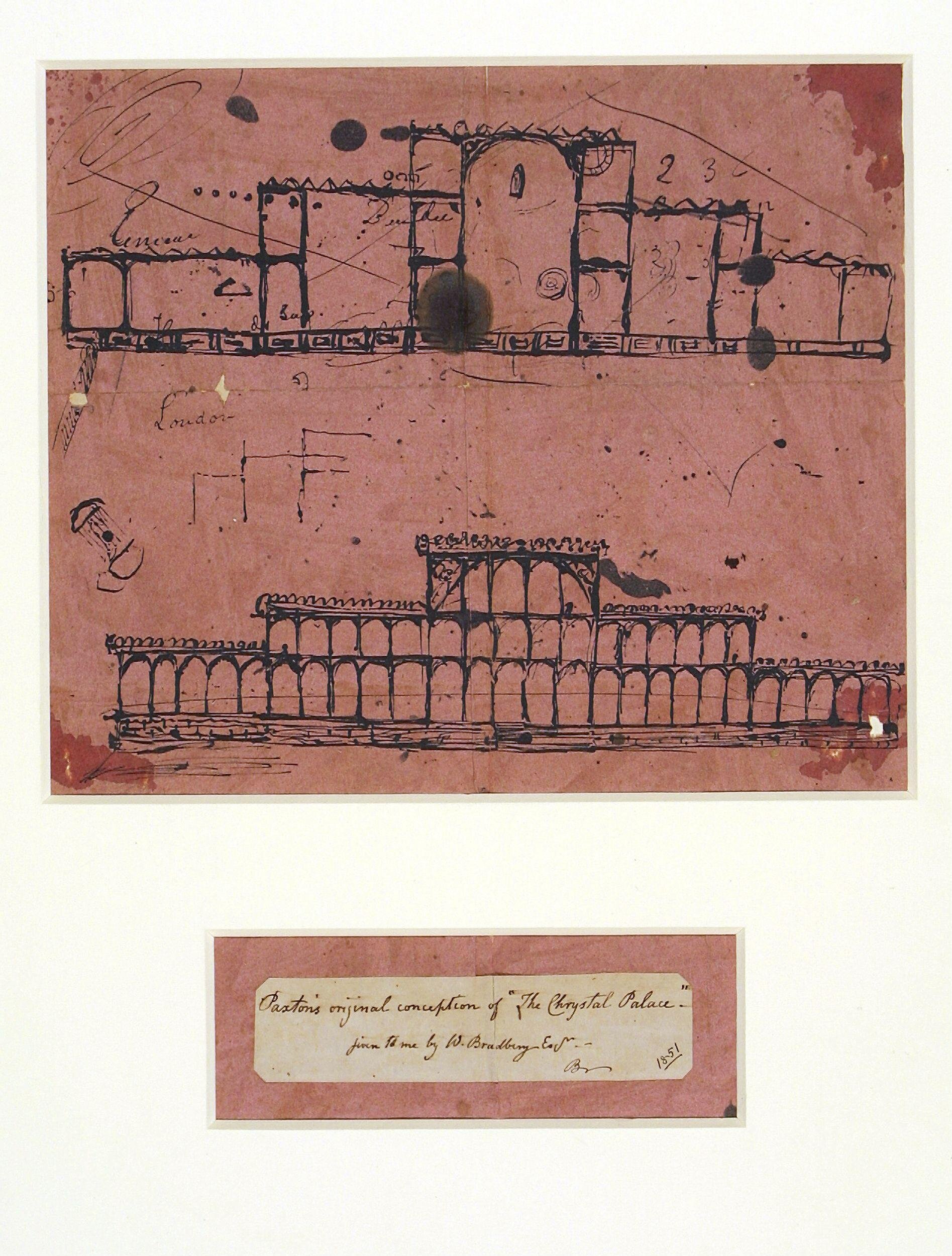
As a final thought it is helpful to look at the plans for and the finished Crystal Palace. Given the above images it is very easy to see the continuity and growth in the design, style, and aesthetic of Paxton as an engineer. I'm left wondering how many engineering milestones were inspired by engineering int he natural world?
 |
| First Sketch of the Crystal Palace |
 |
| Front View of the Crystal Palace |




I think that many engineering milestones were inspired by the natural world. It's the first place to look for information on how to build - from the webs of spiders, to the nests of birds, to the branching of trees - these are all lessons in what works.
ReplyDelete